
More Than Gear, More Than Labels
Walk through almost any major Pride event today and you’ll likely see them.
Some wear brightly coloured hoods and matching harnesses. Others sport custom patches, collars, tails, or simply a small paw badge attached to a jacket. Some travel in large groups representing local Packs, while others walk alone among friends.
Over the past decade, pup play has become one of the most visible and recognisable subcultures within the LGBTQ+ community. Yet despite this visibility, many people still misunderstand what the community represents and why it continues to grow.
For those outside the community, it is often viewed through the lens of the gear. The hood becomes the defining image. The photographs become the story. But for many pups, the reality is far more nuanced.
At its heart, pup culture is not really about the gear at all.
It is about people.
The Search for Belonging
To understand why pup culture resonates with so many gay men, it is worth considering a simple question:
What is it that most people are looking for when they join a community?
For some, the answer is friendship.
For others, it is acceptance.
Some seek confidence. Others seek understanding. Many are simply looking for people who share similar experiences and perspectives.
These desires are hardly unique to the pup community. In many ways, they are woven throughout the history of LGBTQ+ life itself.
For generations, LGBTQ+ people have built communities not merely for celebration, but for survival. Long before acceptance became more widespread, gay men often relied on friendship networks and chosen families to find support, companionship, and understanding. Community spaces became places where people could express themselves honestly without fear of judgement.
While society has changed significantly, the desire to belong remains as powerful as ever.
Many people discover pup culture at a point in their lives when they are seeking connection. Some have recently come out. Others have moved to a new city. Some have lost touch with existing friendship groups. Others simply want to meet people outside traditional dating environments.
What they often discover is not merely a hobby or an identity, but a community.
A Different Kind of Social Space
One reason pup culture has flourished is its ability to create social opportunities that are not solely centred around dating or nightlife.
Historically, many social opportunities for gay men were tied to bars, clubs, and nightlife venues. While these spaces remain important, they are not always what everyone is looking for.
Increasingly, communities are forming around shared interests and activities rather than simply shared identities.
Board game nights.
Bowling leagues.
Coffee meetups.
Charity fundraising.
Walking groups.
Community events.
These gatherings may seem ordinary from the outside, but they serve an important purpose. They create opportunities for genuine friendships to develop naturally.
Many pups will tell you that some of their closest friendships began not through dating apps or nightlife venues, but through local community events where conversation and shared experiences came first.
The hood may have introduced them to the community, but friendship is often what keeps them there.
The Freedom to Be Playful
There is another reason pup culture resonates with so many people, and it is perhaps one of the least discussed.
Modern adult life can be exhausting.
Work, finances, responsibilities, social expectations, and everyday pressures leave little room for play. As children, most people are encouraged to be imaginative, creative, and spontaneous. As adults, those opportunities often become increasingly limited.
Pup culture offers a rare opportunity to reconnect with that sense of playfulness.
For some people, putting on a hood or embracing a pup persona allows them to temporarily step away from daily responsibilities and engage with a simpler, more carefree side of themselves. It creates a space where fun, creativity, and spontaneity are not only accepted but actively encouraged.
This experience is often referred to as “headspace,” although it varies considerably from person to person.
What matters is not achieving a particular mindset, but having permission to relax, enjoy oneself, and interact with others without the expectations that often accompany adult life.
In a world that constantly demands seriousness, there is something profoundly liberating about being playful.
Identity Without Expectations
Gay culture, like any culture, sometimes carries its own expectations.
Ideas about appearance.
Ideas about masculinity.
Ideas about confidence.
Ideas about success.
While many people navigate these expectations comfortably, others find them restrictive.
One of the strengths of pup culture is that it often creates space for people who feel disconnected from traditional social expectations.
Within the community, people frequently find themselves valued not for how they look, what they do for a living, or how socially confident they appear, but for how they contribute to the group.
Someone may be known as the organiser who keeps events running smoothly.
Another may be the friend who welcomes every newcomer.
Someone else may be recognised for their creativity, humour, kindness, or enthusiasm.
The result is a community where people often feel able to express aspects of themselves that might otherwise remain hidden.
Chosen Family in a Modern World
Perhaps the most powerful connection between pup culture and wider gay culture is the concept of chosen family.
The idea of chosen family has long been central to LGBTQ+ communities. It reflects the reality that meaningful support networks are not always defined by biology or traditional structures. Instead, they are created through trust, shared experiences, and mutual care.
Many Packs function in a similar way.
While the term “Pack” may sound formal, most are simply friendship groups united by common interests and experiences. They celebrate milestones together, organise events, support one another through challenges, and create a sense of belonging that extends beyond occasional social gatherings.
Not every pup belongs to a Pack.
Not every Pack operates in the same way.
But the underlying principle remains familiar: people supporting people.
In many respects, this tradition continues a long history of community-building within LGBTQ+ culture.
Looking Beyond the Stereotypes
As pup culture has become more visible, it has inevitably attracted attention and misconceptions.
Some assume the community is defined entirely by gear.
Others assume it revolves around a single type of experience or lifestyle.
The reality is far more diverse.
The community includes students, healthcare workers, engineers, artists, teachers, tradespeople, gamers, athletes, and professionals from every imaginable background. Some are highly active within local communities, while others participate occasionally. Some wear extensive gear collections. Others own little more than a collar or a paw badge.
What connects them is not a uniform appearance or shared background.
It is a shared appreciation for community, self-expression, friendship, and belonging.
More Than a Subculture
As pup culture continues to grow throughout the United Kingdom and beyond, its significance extends beyond the labels often attached to it.
For many people, it has become a gateway to confidence.
For others, it has provided friendships that changed their lives.
Some have discovered local communities where they finally felt accepted.
Others have simply found opportunities to laugh, socialise, and enjoy themselves among friends.
In an increasingly digital world where genuine connection can sometimes feel difficult to find, that may be the community’s greatest achievement.
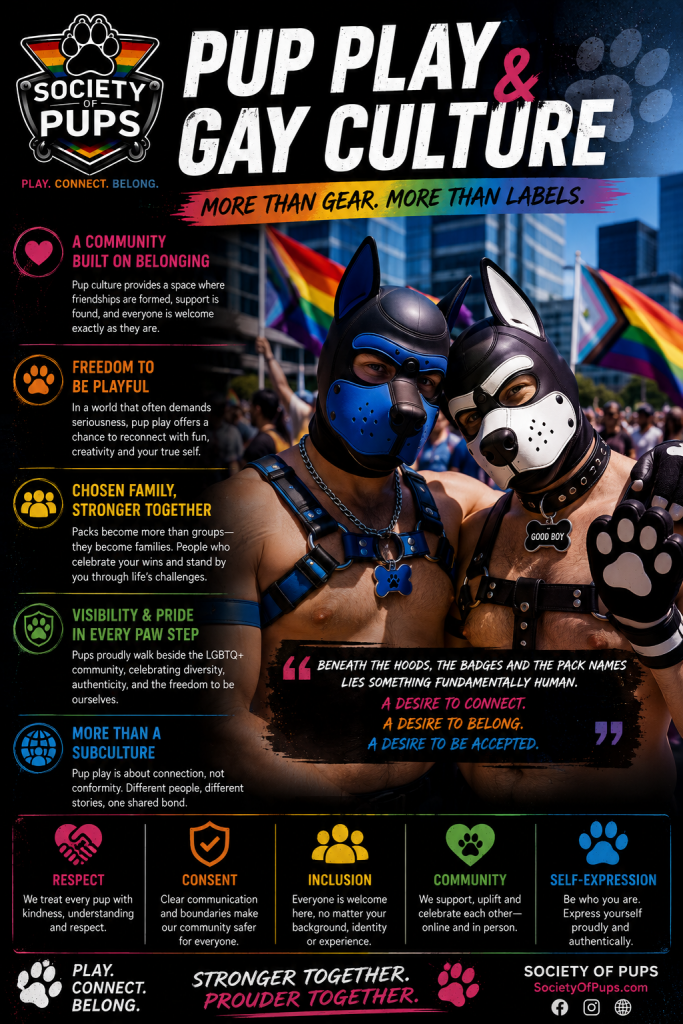
Because beneath the hoods, the badges, the Pack names, and the terminology lies something fundamentally human.
A desire to connect.
A desire to belong.
And a desire to find people who accept us for who we are.
That story is not unique to pup culture.
In many ways, it is the story of gay culture itself.
Play. Connect. Belong. 🐾
The Barking Post – SocietyOfPups.com