
Guidance, Trust, and Community
When people first discover the pup community, one of the terms they often encounter is “Handler.”
Handlers are frequently seen alongside pups at events, social gatherings, Pride celebrations, and within local Packs. Yet despite their visibility, many newcomers are unsure what the role actually involves.
Some assume a Handler is simply someone who owns a pup. Others imagine a rigid hierarchy or formal structure. The reality is usually much more diverse.
Like many aspects of the pup community, the role of a Handler is shaped by the individuals involved. There is no universal definition, no single way of participating, and no expectation that every pup must have a Handler.
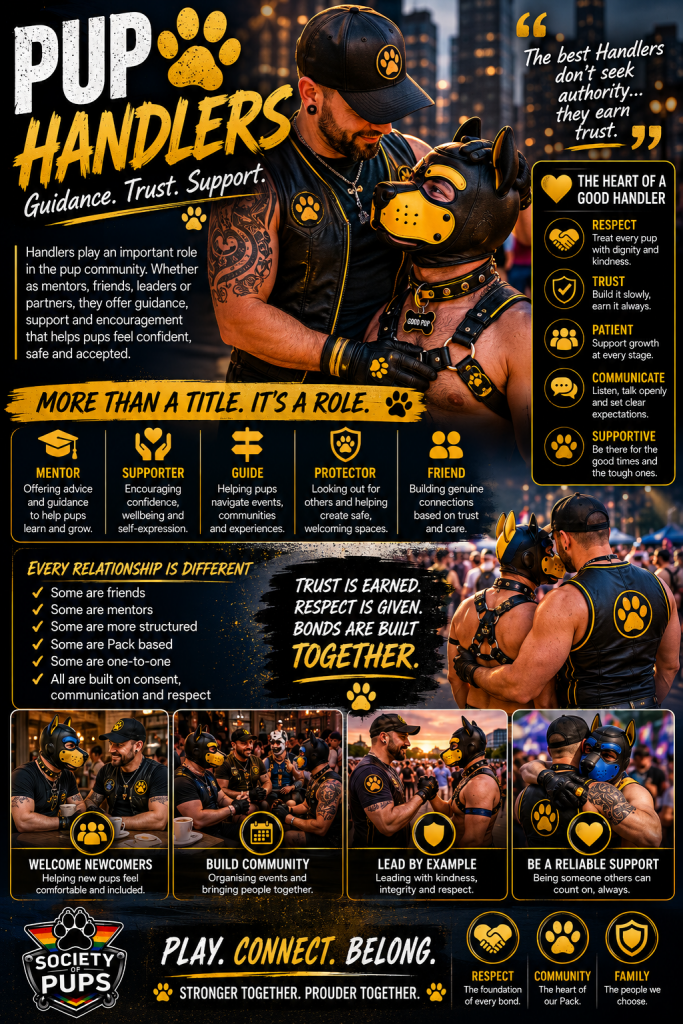
At its core, being a Handler is often about guidance, trust, support, and connection.
What Is a Handler?
A Handler is someone who takes on a supportive role within the pup community.
For some, this may involve helping a pup navigate events, offering encouragement, providing mentorship, or simply being a trusted friend. For others, the role may form part of a more structured relationship built around clearly defined expectations and responsibilities.
The role itself can vary enormously.
Some Handlers work closely with a single pup, while others support entire Packs or local communities. Some are heavily involved in organising events and welcoming newcomers. Others prefer quieter, one-to-one relationships focused on friendship and guidance.
What unites most Handlers is a desire to help others grow, feel supported, and enjoy their place within the community.
More Than Leadership
One of the most common misconceptions about Handlers is that they are automatically leaders.
While many Handlers possess leadership qualities, the two roles are not necessarily the same.
Leadership often focuses on directing groups, organising activities, and helping communities function effectively. Handling, on the other hand, is often more personal.
Many Handlers see themselves as mentors rather than leaders.
They may offer advice to newer members, help someone build confidence before attending their first event, or simply provide a calm and reliable presence within a social group.
In many cases, the most effective Handlers are not those seeking authority, but those who genuinely enjoy supporting others.
The Importance of Trust
Trust is often described as the foundation of any successful Handler relationship.
Whether the relationship is based on friendship, mentorship, social support, or something more structured, trust allows both individuals to feel safe, respected, and understood.
Trust is built over time through:
- Honesty
- Consistency
- Communication
- Reliability
- Respect
It cannot be demanded and it cannot be rushed.
Strong Handler relationships often develop naturally through shared experiences and mutual understanding rather than formal titles alone.
Supporting New Members
For many newcomers, entering the pup community can feel intimidating.
Questions quickly arise:
What gear should I buy?
What events should I attend?
How do I meet people?
What do all these terms mean?
Experienced Handlers often help answer these questions.
Many become informal ambassadors for the community, helping newcomers understand social etiquette, community expectations, and local opportunities for involvement.
Their guidance can make the difference between someone feeling overwhelmed and someone feeling welcomed.
Handlers as Community Builders
Beyond individual relationships, many Handlers play an important role in strengthening local communities.
Across the UK and around the world, Handlers can often be found:
- Organising socials
- Supporting local Packs
- Welcoming newcomers
- Helping resolve disputes
- Encouraging inclusion
- Mentoring newer members
While these contributions often happen behind the scenes, they help create the safe and welcoming environments that allow communities to thrive.
Many of the strongest communities are built upon the efforts of people who rarely seek recognition for their work.
Communication Is Key
If there is one lesson that applies to every Handler relationship, it is the importance of communication.
Every person has different expectations, boundaries, interests, and goals.
Open conversations help ensure everyone understands:
- Roles and responsibilities
- Personal boundaries
- Expectations
- Comfort levels
- Communication preferences
Healthy relationships are built on mutual understanding rather than assumptions.
The strongest Handler relationships are often those where communication remains ongoing rather than being treated as a one-time conversation.
There Is No “Perfect” Handler
Another misconception is that Handlers must fit a particular stereotype.
Some people imagine Handlers as highly experienced authority figures with years of knowledge and leadership experience.
In reality, Handlers come from every background imaginable.
Some are outgoing organisers.
Some are quiet mentors.
Some are experienced community veterans.
Others are relatively new members who naturally enjoy supporting friends and helping people feel included.
What matters most is not experience or status, but character.
Patience, kindness, empathy, reliability, and respect often define great Handlers far more than titles ever could.
The Value of Support
Perhaps the greatest contribution Handlers make is helping people feel supported.
Modern life can be isolating.
Many people arrive in the community looking for friendship, acceptance, and a sense of belonging. Knowing that someone is willing to listen, offer guidance, or simply check in from time to time can have a meaningful impact.
The best Handlers understand that support is not about control.
It is about helping people feel confident enough to grow into themselves.
Every Community Needs Handlers
Strong communities require many different types of people.
They need organisers.
They need leaders.
They need social butterflies.
They need newcomers bringing fresh perspectives.
And they need people who are willing to support, guide, and encourage others.
Handlers often fulfil that role.
Through friendship, mentorship, patience, and trust, they help strengthen the connections that bring communities together.
At Society of Pups, we believe that communities thrive when people support one another. Whether someone identifies as a Handler, a pup, a Pack member, or simply a friend, every positive contribution helps create a stronger and more welcoming community.
Because sometimes the most important role isn’t leading the Pack.
It’s helping others find their place within it.
Play. Connect. Belong. 🐾
The Barking Post – SocietyOfPups.com