
Understanding Overlap, Identity, and Community
One of the most common questions asked by people who are new to the pup community is whether pup play is connected to other kinks and fetishes.
The answer is both simple and surprisingly complex.
For some people, pup play exists entirely on its own. Their involvement centres around community, friendship, gear, roleplay, social events, and self-expression. For others, pup play overlaps with broader kink interests and becomes one part of a wider exploration of identity, relationships, and personal expression.
Neither approach is more valid than the other.
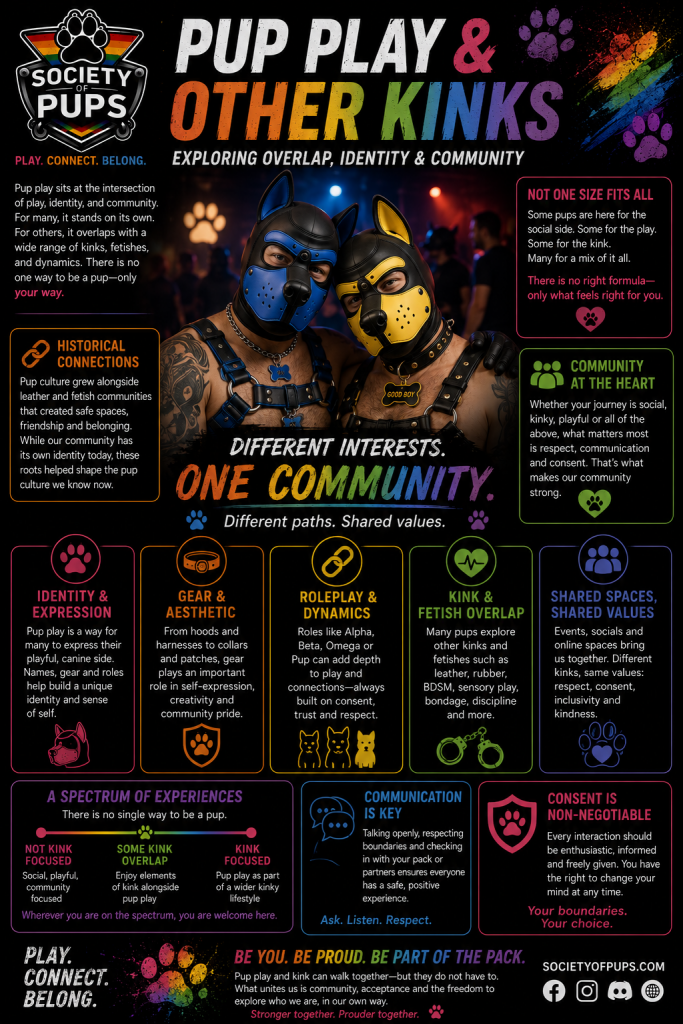
Like many aspects of LGBTQ+ culture, pup play exists on a spectrum of experiences, and the way one individual participates may be completely different from someone else’s journey.
Understanding these overlaps helps explain why the pup community is so diverse and why it continues to attract people from many different backgrounds.
A Community Rather Than a Single Experience
One reason newcomers are sometimes confused about pup play is that it cannot easily be placed into a single category.
It is not purely a hobby.
It is not purely a social group.
It is not purely a form of roleplay.
Nor is it exclusively connected to kink.
Instead, pup culture often exists at the intersection of several different communities.
For some members, the appeal lies primarily in the playful, social aspects of pup identity. For others, it may be connected to wider interests within leather, rubber, BDSM, fetish gear, role-based dynamics, or other forms of consensual adult expression.
The result is a community where people with very different interests often find common ground.
The Importance of Personal Choice
One of the defining characteristics of the modern pup community is that there is no expectation that members share the same interests beyond mutual respect and community participation.
Some pups attend events simply to socialise with friends.
Some enjoy collecting gear and developing unique pup identities.
Others participate in role-based relationships.
Many combine elements from several different interests.
The key point is that participation is always personal.
The pup community is not defined by any particular kink, dynamic, or activity. Individuals choose which aspects resonate with them and which do not.
This flexibility has helped make the community accessible to a wide range of people.
The Historical Connection to Leather Culture
To understand why pup play is often associated with other kink communities, it helps to look briefly at history.
Many of the earliest visible pup communities emerged alongside established leather and fetish communities within gay culture.
For decades, leather communities provided social spaces where people could explore identity, develop friendships, and build chosen families. Events, clubs, gatherings, and community organisations created opportunities for people with shared interests to connect.
As pup culture grew in visibility, many pups naturally found themselves participating in these existing spaces.
This historical overlap helped introduce pup culture to wider audiences and contributed to its rapid growth across Europe, North America, Australia, and beyond.
Today, while many pups maintain strong connections with leather communities, pup culture has also developed its own independent identity and social structures.
Gear and Visual Identity
One area where overlap often becomes visible is through gear.
Many pups enjoy wearing:
- Harnesses
- Collars
- Leather accessories
- Rubber gear
- Neoprene clothing
- Custom patches
- Branded apparel
These items may also appear within other fetish communities, although their meaning can differ significantly depending on context.
For some people, gear represents identity and self-expression.
For others, it reflects craftsmanship, fashion, creativity, or community affiliation.
What matters is not the gear itself but the meaning individuals attach to it.
A harness, collar, or patch may signify friendship, belonging, pride, personal achievement, or simply appreciation for a particular aesthetic.
Role Dynamics and Shared Language
Another area where communities sometimes overlap involves role-based identities.
Within the pup community, people often describe themselves using terms such as:
- Alpha
- Beta
- Omega
- Pack Pup
- Lone Pup
- Handler
These labels help some individuals describe aspects of their personality, social role, or preferred way of interacting within a group.
Similarly, other kink communities often utilise their own terminology to describe relationships, responsibilities, preferences, or dynamics.
While the language may differ, the underlying principle is often similar: creating frameworks that help individuals understand themselves and communicate effectively with others.
Importantly, no role automatically implies authority, hierarchy, or obligation. Every relationship remains unique and should always be built upon communication, mutual understanding, and consent.
Community Through Shared Interests
Perhaps the most significant overlap between pup culture and other kink communities is not found in gear or terminology but in the value placed on community itself.
Many people are initially drawn to niche communities because they provide opportunities to meet others who share similar interests.
These communities often create spaces where individuals can:
- Express themselves openly
- Develop confidence
- Build friendships
- Learn from others
- Participate in events
- Find acceptance
For many people, the friendships formed through these communities become far more important than the interests that originally brought them together.
This is one reason why local social groups, coffee meetups, board game nights, bowling teams, Pride gatherings, and community events remain so popular.
They allow relationships to develop beyond labels and identities.
Breaking Down Misconceptions
Public perceptions of kink communities are often shaped by stereotypes.
People sometimes assume that every member shares identical interests, experiences, or motivations.
The reality is far more diverse.
Within any pup community, you may encounter people who are:
- Primarily interested in social connection
- Focused on community building
- Passionate about gear and creativity
- Interested in roleplay
- Active in other fetish communities
- Not involved in kink at all
This diversity is one of the community’s greatest strengths.
It allows people to participate in ways that feel comfortable and authentic to them rather than conforming to a predefined expectation.
Respecting Differences
As communities grow, diversity of experience becomes increasingly important.
Not every pup enjoys the same activities.
Not every Handler has the same approach.
Not every member participates in the same way.
Healthy communities recognise these differences and create space for individuals to make their own choices.
Respect for boundaries, consent, communication, and personal autonomy allows people with varied interests to coexist within the same broader community.
The result is a culture where individuals can explore, learn, and connect without pressure to fit a particular mould.
More Than Labels
Ultimately, the relationship between pup play and other kink communities reflects something larger than any single interest.
It reflects a shared desire for connection.
People seek communities where they feel understood.
They look for opportunities to express themselves authentically.
They build friendships, support networks, and chosen families around common experiences.
Whether someone identifies solely as a pup, participates in several overlapping communities, or simply enjoys attending local socials, the foundation remains the same.
Community.
Friendship.
Acceptance.
The labels may differ, but the human desire behind them is remarkably familiar.
And perhaps that is why so many people continue to find a home within these communities—not because of the gear they wear or the terminology they use, but because of the people they meet along the way.
Play. Connect. Belong. 🐾
The Barking Post – SocietyOfPups.com